


Surface Treatment Know-How: Surface Energy, Contact Angle, Dyne Levels & More
Comments Off on Surface Treatment Know-How: Surface Energy, Contact Angle, Dyne Levels & MoreChoosing the Right Surface Treatment System
Why Many Materials Have Adhesion Challenges
When inks bead up, coatings fail to wet out, or adhesives do not bond reliably, the root cause is often insufficient surface energy on the substrate. Several inherent properties of polymers, glass, compounds, and metals can make adhesion challenging. Many surfaces are extremely smooth and non-porous, preventing inks and adhesives from penetrating or mechanically anchoring to the substrate. For example, polymers are often the material of choice in manufacturing, but their chemistry naturally resists bonding with applied media.
In addition, surfaces frequently accumulate contaminants such as oils, dust, and processing residues that further interfere with bonding. These factors contribute to low surface energy, causing inks, coatings, or adhesives to bead rather than spread across the substrate, resulting in poor wetting and unreliable adhesion.
Surface pretreatment technologies such as corona and atmospheric plasma are widely used to solve these challenges by increasing surface energy and improving wettability prior to printing, coating, or bonding operations. These industrial surface treatment technologies are essential across numerous manufacturing sectors.
Corona vs. Atmospheric Plasma Surface Treatment
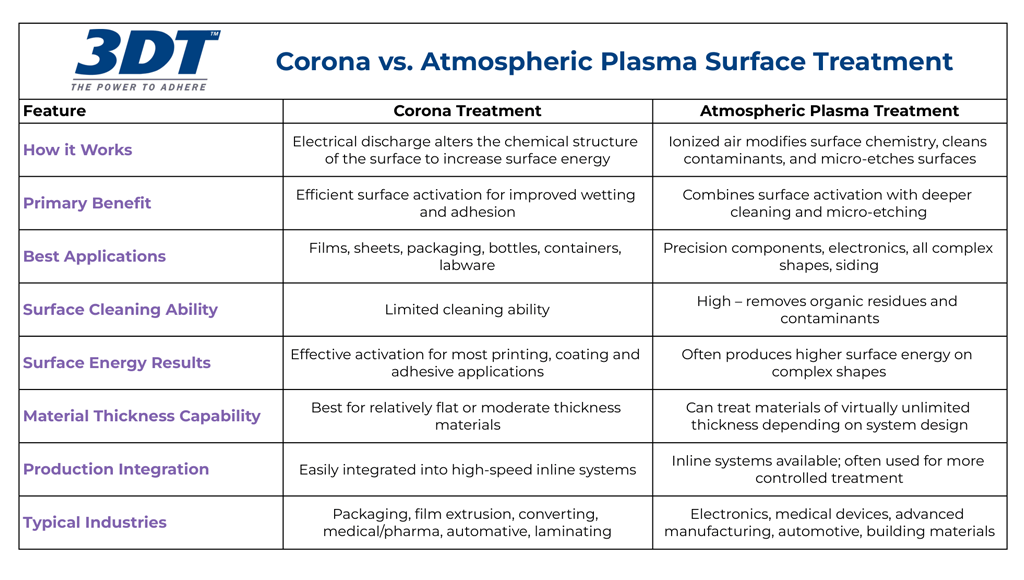
Both corona and atmospheric plasma treatments use electrical discharge to activate the surface. However, the way energy is delivered differs, which affects how each technology is applied in manufacturing environments.
What Is Corona Surface Treatment?
Corona surface treatment increases surface energy by altering the chemical structure of the material’s surface. Corona discharge surface treatment is commonly used to improve wettability and adhesion performance on polymer-based substrates, glass, and more.

Key benefits include:
- Increases surface energy by altering the chemical structure
- Typically produces highly effective activation and durable adhesion
- Excellent for fast line speeds and wide sheets and film, bottles, labware, and more
- Can be easily integrated into bottle, sheet and labware production lines
- Often more economical than plasma systems when treating larger items
Corona treatment is commonly used in high-speed film and web production environments where large surface areas must be treated efficiently.
Corona treatment is a valuable technology due to its ability to improve the functionality of numerous materials for a wide range of applications. It’s affordable and highly effective.
What Is Atmospheric Plasma Surface Treatment?
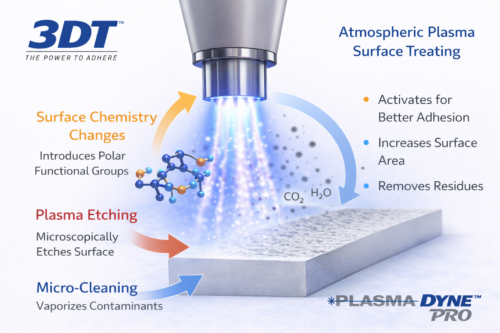
Atmospheric plasma surface treatment provides both surface activation, intensive cleaning, and micro-etching. Atmospheric plasma treatment can deliver highly uniform surface energy levels while removing contamination that interferes with adhesion.
Benefits include:
- Modifies surface chemistry resulting in improved adhesion
- Provides more intense surface cleaning
- Finely micro-etches surfaces, enabling stronger physical bonding
- Often produces higher and more uniform surface energy levels
- Particularly effective at removing organic contamination and residues
- Creates potential-free surface treatment allowing treatment on or near metal, useful for embedded circuitry and circuit boards
- Atmospheric plasma systems operate without a vacuum chamber enabling faster inline processing
Plasma treatment is especially valuable for applications involving complex geometries, precision components, and sensitive electronic materials.
Corona vs. Atmospheric Plasma Surface Treatment
How Surface Energy Is Measured
Surface activation can be verified using two common methods: contact angle measurement and dyne level testing. Both are methods of adhesion testing.
Contact Angle Measurement for Surface Energy
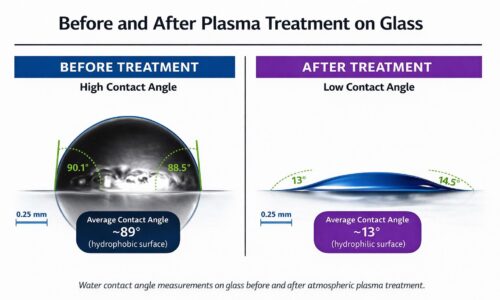
Contact angle measurement evaluates the angle formed by a droplet of liquid placed on a surface using a digital surface analyzer. This method provides a clear visual indication of how surface treatment affects wettability.
Untreated substrates often exhibit contact angles well above 60°, indicating poor wetting. After plasma or corona treatment, contact angles commonly drop below 30°, demonstrating significantly improved surface energy and wetting. In some cases, plasma surface treatment can achieve contact angles in the single-digit to low-teen range, indicating highly activated surfaces.
Dyne Level Testing for Adhesion and Wetting
Surface energy can also be evaluated using dyne solution, typically delivered using dyne inks or dyne pens. Dyne level measures the surface energy of a substrate in energy units referred to as dynes/cm. Understanding the dyne level of a substrate is critical to obtaining correct adhesion of media and product performance.
For example, reliable digital printing ink adhesion generally requires surface energy levels of approximately 50 dynes/cm or higher.
This range works well because:
- Most UV-curable digital inks have surface tensions between 30–45 dynes/cm
- For proper wetting, the substrate surface energy should exceed the ink surface tension by about 10 dynes/cm
- When this condition is met, ink spreads uniformly rather than forming droplets
Both corona and atmospheric plasma treatment can easily raise surface energy into this range. Learn more about dyne level testing on our Blog What is Dyne Level?
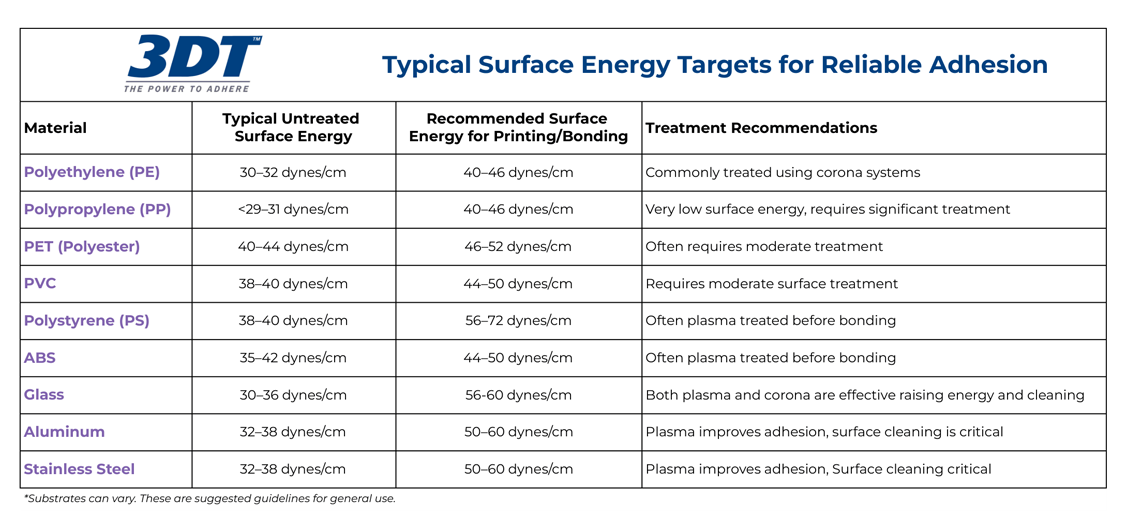
Below is a chart displaying many materials used in manufacturing, their untreated surface energy and recommended surface energy for successful bonding and printing.
3DT Surface Pretreatment Systems for Manufacturing
Reliable adhesion begins with proper surface preparation. Surface pretreatment plays an important role in achieving consistent printing, coating, cleaning, and bonding results.
For more than 35 years, 3DT LLC has developed innovative corona and atmospheric plasma systems designed to address numerous manufacturing challenges. Our systems provide the technology to raise surface tension to highly functional levels on numerous materials for strong adhesion and product performance.
3DT’s Systems are Fully Customizable
Every system from 3DT is customizable for your particular application. We offer a wide range of automation and material handling options as well. Our experienced team will engineer a system that meets your specific production needs ensuring efficiency, precision, seamless integration and highly functionalized surfaces.
These surface treatments support a wide range of industries including packaging, electronics, automotive, and surface treatment for medical devices.
Featured Surface Treatment Systems from Manufactured by 3DT
Learn more about these systems and our full line of corona and plasma surface treatment systems here.
Corona Treatment Systems
PolyDyne Pro: Powerful corona treatment system that includes custom-built product handling and enclosure systems tailored to specific 3D part applications.
HeliDyne: A patented corona treatment system designed for wide and thick materials such as foam, composites, and polymer panels. HeliDyne can treat materials up to 2 inches thick and 120 inches wide.
FlexiDyne: A compact, self-contained corona treating unit with an integrated conveyor. FlexiDyne effectively treats a wide variety of three-dimensional parts including labware, lenses, lids, etc.
UltraDyne: Designed to raise surface energy for high-speed printing, extrusion, coating, and assembly lines. Also, ideal for printing lines, processing cups, tubs, tubes and other containers.
Atmospheric Plasma Systems
PlasmaDyne Pro: An advanced, Smart atmospheric plasma system designed to remove contaminants, micro-etch the surface while improving chemical make-up raising surface energy for reliable bonding. Especially useful when surface treating complex shapes.
PlasmaTraverse: A powerful plasma system capable of treating materials of virtually unlimited thickness. PlasmaTraverse can safely treat sensitive materials such as silicon wafers, plastic film, foam and glass.
Conclusion: Why Surface Pretreatment Improves Manufacturing Results
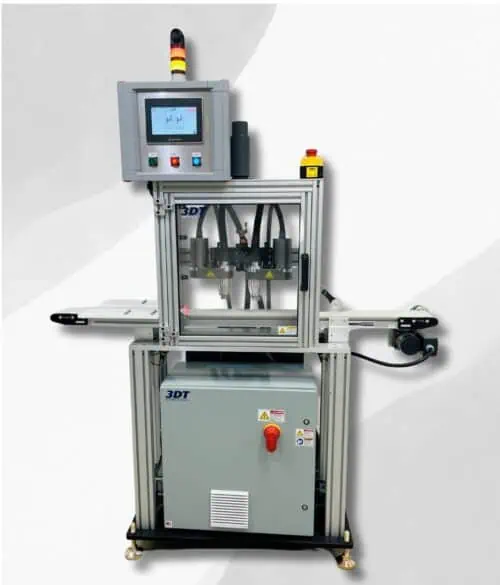
Surface pretreatment plays a critical role in improving adhesion, product quality, and manufacturing efficiency. By increasing surface energy and removing contaminants, corona and atmospheric plasma technologies enable reliable bonding of inks, coatings, and adhesives across a wide range of materials.
Selecting the appropriate surface treatment system depends on the material, media, application, and production requirements. With the right technology and process expertise, manufacturers can significantly improve both production consistency and product performance. Give us a call, fill out a form on the website, or send us an email. Let’s solve your adhesion challenges through our advanced coating and surface treatment solutions.
