


Automotive EPDM Solutions
EPDM rubber is widely used in automotive sealing systems such as door gaskets, window seals, trunk seals, and HVAC components. While it performs well in harsh environmental conditions, EPDM presents a consistent manufacturing challenge: its surface has very low surface energy, which limits adhesion with coatings, inks, and adhesives.
Without surface modification, bonding failures can occur during assembly or after exposure to heat, moisture, and mechanical stress. This results in product rework, reduced service life, and inconsistent production performance.
3DT LLC provides industrial surface treatment systems that modify EPDM surfaces prior to coating or bonding processes. These systems use controlled plasma surface treatment and corona discharge technology to increase surface activity, allowing coatings and adhesives to perform reliably in production environments.
EPDM Surface Challenges in Automotive Manufacturing
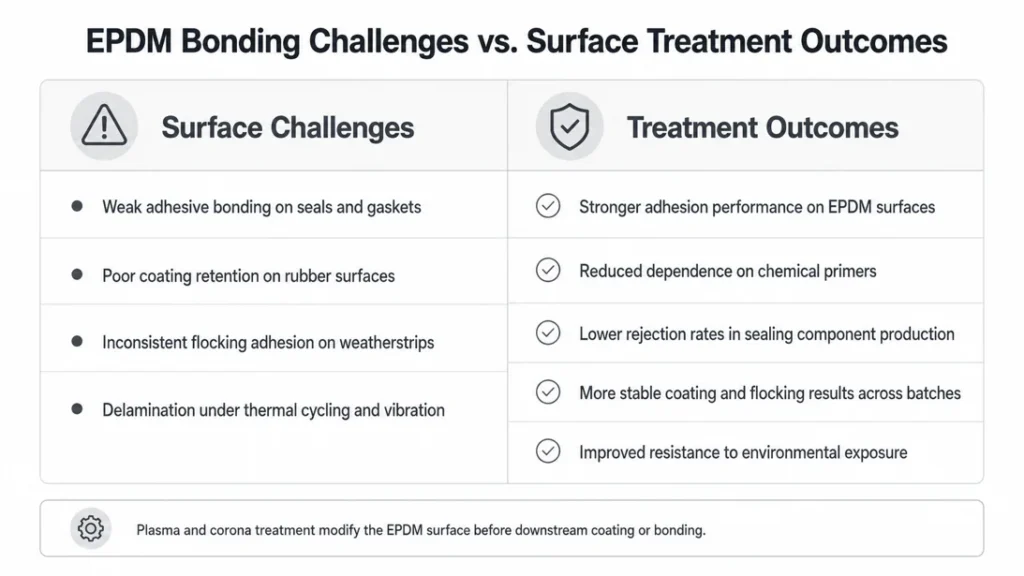
EPDM is chemically inert and non-polar, which makes it resistant to bonding materials commonly used in automotive sealing systems. This leads to recurring issues such as:
- Weak adhesive bonding on seals and gaskets
- Poor coating retention on rubber surfaces
- Inconsistent flocking adhesion on weatherstrips
- Delamination under thermal cycling and vibration
These limitations affect both appearance and functional performance, especially in high-demand sealing applications. 3DT systems address this issue at the surface level, where bonding performance begins.
Industrial Surface Treatment Systems for EPDM
3DT provides industrial surface treatment equipment that activates EPDM surfaces prior to downstream processing. The systems operate as inline or standalone stations depending on production requirements.
Key system categories include:
- Corona discharge systems for continuous EPDM profiles and extrusion lines
- Atmospheric plasma systems for 3D molded or complex geometries
- Jet-based plasma treatment units for localized surface activation
- Inline integration systems for high-volume automotive production
Each system modifies the EPDM surface at a molecular level, increasing surface energy and improving compatibility with coatings and adhesives used in automotive manufacturing.
Plasma Surface Treatment for EPDM Components
Plasma surface treatment is used to activate EPDM without altering the bulk material. The process introduces reactive species (highly active atoms or molecules) onto the surface, improving wettability and adhesion performance.
This is applied to:
- Extruded sealing profiles
- Molded rubber components
- Complex gasket assemblies
- Multi-material sealing interfaces
The process runs without physical contact, which helps maintain dimensional integrity of the rubber components. It also supports integration into fast-moving production lines where cycle time control is critical.
Coating and Surface Treatment Applications
Coating and surface treatment on EPDM depend heavily on surface preparation. 3DT systems activate EPDM before coating or bonding steps, improving how materials interact with the surface.
Typical applications include:
- Adhesive bonding for multi-part seal assemblies
- Surface coating for weather resistance and durability
- Flocking application on door and window seals
- Printing and marking on rubber components
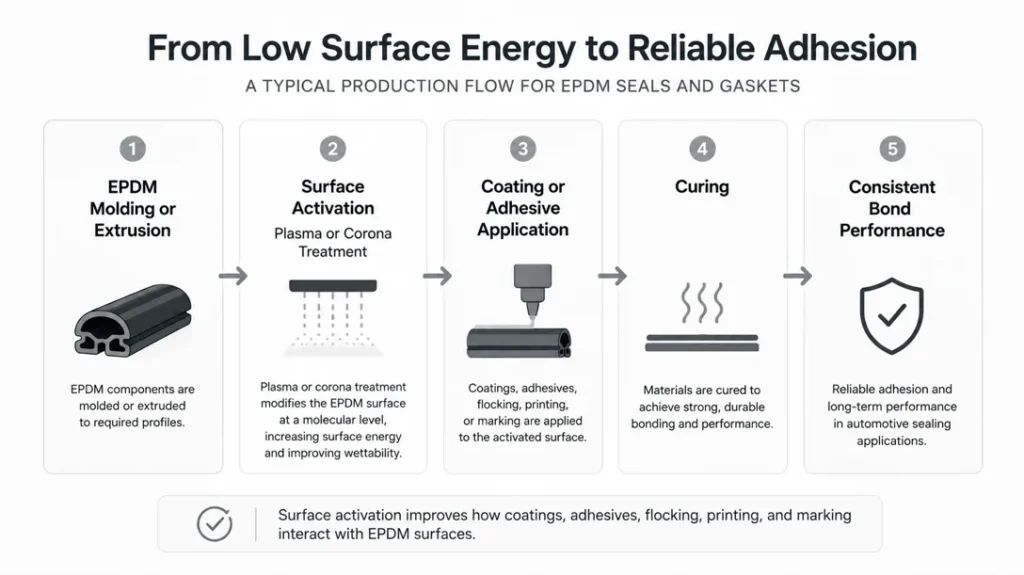
A typical production flow includes EPDM molding or extrusion, surface activation using plasma or corona treatment, followed by coating or adhesive application and curing. This sequence improves bond consistency across production batches.
Automotive EPDM Use Cases
3DT surface treatment systems are used across multiple automotive sealing applications:
- Door seals: improved flocking adhesion and reduced noise leakage
- Window gaskets: stronger adhesive bonding for structural assembly
- Trunk and hood seals: resistance to vibration and weather exposure
- HVAC sealing systems: stable performance under temperature variation
- EV platforms: multi-material bonding between rubber, plastic, and metal components
These applications rely on consistent adhesion performance to maintain sealing integrity over the vehicle lifecycle.
Production Integration and System Support
3DT systems are designed for direct integration into automotive manufacturing lines. Equipment can be installed as part of extrusion, molding, or post-processing stages.
Integration support includes:
- Line-speed matching for continuous production
- PLC-based control integration
- Process parameter calibration for specific EPDM formulations
- Validation testing for adhesion performance consistency
Systems are used by manufacturers moving from manual surface preparation methods to controlled inline processing.
Performance Outcomes for EPDM Processing
Use of plasma surface treatment and corona treatment systems deliver measurable production improvements:
- Stronger adhesion performance on EPDM surfaces
- Reduced dependence on chemical primers
- Lower rejection rates in sealing component production
- More stable coating and flocking results across batches
- Improved resistance to environmental exposure
These outcomes support both production efficiency and long-term product reliability.
Engineering Support for Application Development
3DT works directly with manufacturers during process development and surface treatment validation. This includes sample testing, parameter tuning, and production trial for EPDM-based components. Our team focuses on achieving stable adhesion results under production conditions, including line speed, material variation, and downstream processing requirements.
3DT – Experience and Solutions
3DT has 35 years of experience in the manufacture of surface treatment machinery for the automotive industry. We manufacture a full line of customizable surface treatment systems designed to address a wide range of industrial adhesion challenges. Systems can be engineered around the specific material, part geometry, production process, treatment requirements, and overall cost considerations.
For automotive EPDM applications, 3DT’s PlasmaDyne Pro and PolyDyne Pro are versatile solutions for treating seals, gaskets, sheets, and other components. PlasmaDyne Pro uses atmospheric plasma to simultaneously modify surface chemistry, clean contaminants, and micro-etch the surface—three critical functions that improve bonding and adhesion. PolyDyne Pro is a versatile corona treatment system capable of treating both sheets and three-dimensional parts and thereby improving adhesion. Surface treatment prepares EPDM and other difficult-to-bond materials to accept adhesives, inks, coatings, laminates, and paints more effectively.
EPDM Won’t Bond Itself. Fix That Before It Reaches the Line.
Get consistent adhesion for EPDM seals and gaskets with industrial surface treatment systems from 3DT LLC. Whether it’s coating, printing, or bonding, surface activation using plasma or corona technology improves performance right at the source. Talk to 3DT about integrating a surface treatment solution into your production line.