Direct digital printing to plastic is challenging, but that doesn’t make it impossible. Variables such as low surface energy, the variations of plastic, how it is manufactured and the printing process all play a role when it comes to ensuring ink initially adheres to the surface and remains there for the intended duration.
Here are two great opportunities to learn more about the nuances of improving printing on plastic with inkjet printing. First, read the answers to Industrial Print’s questionnaire supplied by plastics industry experts Scott Sabreen, of the Sabreen Group and Erik Kiel, of 3DT. Then, listen to the webinar to hear Sabreen and other industry experts discuss strategies for improving printing to plastic. The webinar is a companion to the article. It was held November 2025 and hosted by Industrial Print magazine.
Scott Sabreen and Erik Kiel are coauthors on the questions below for the article Plastics Possibilities – Direct Printing, in Industrial Print’s 11/25 issue. Between these two industry veterans there are 70 years of knowledge on surface treatment technology.
 Sabreen is known internationally for his work in inventing and developing leading-edge process technologies in the fields of laser marking, adhesion bonding, plasma chemical pretreatments, product security, decorating & finishing, digital mass customization, and pharmaceutical manufacturing. Sabreen has consulted for 525 companies in 34 countries. SABREEN’S game-changing processes result in lower-cost manufacturing, six-sigma quality, and critical market advantages.
Erik Kiel is the founder, president, and owner of 3DT LLC. For nearly 35 years, he has led the company with a commitment to innovation, quality, and customer-focused solutions. Under his guidance, 3DT has become a pioneer in reliable corona and plasma surface treatment technology. 3DT manufactures advanced surface treatment systems engineered for precision, consistency, and long-term performance. 3DT’s standard and custom equipment improve surface energy to achieve exceptional adhesion and bonding across a wide range of materials and applications.
3DT and The SABREEN Group are independent companies that work together to advance the science of plasma pretreatments and integrate surface treatment process solutions for bonding, coating and printing, chemical synthesis, membrane technology, and surface processing. The two companies have partnered on numerous surface treatment projects for nearly 35 years solving some of the most difficult adhesion and process challenges.
Q & A Industrial Print & Sabreen/3DT
1. Direct printing to plastic is challenging for a number of reasons. Can you share some of these reasons and why?
Aside from traditional analog methods (pad/screen printing, offset, hot stamping), direct “digital” printing processes include: a) piezoelectric drop-on-demand inkjet, b) laser marking, and c) toner-based.

A major contributing factor to ink-substrate compatibility is that many plastics are chemically inert, nonporous surfaces with low surface energy and thus require surface pretreatment. Depending upon the application, each of these processes offers certain advantages and limitations. With the exception of laser and hot stamping, all ink printing processes require the liquid ink chemistry (UV, solids, thermal, etc.) to be compatible with the plastic substrate to achieve proper surface wetting. UV inks are typically lower in viscosity (approximately 25dynes/cm) than pad or screen-printing inks wherein surface tension and surface energy necessitate careful measurement.
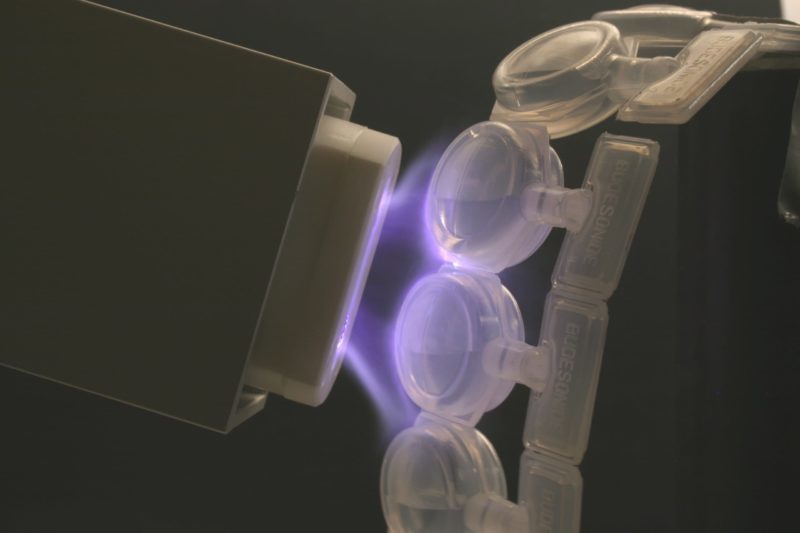
Gas phase “glow discharge” plasma surface pretreatments are generally necessary to achieve acceptable ink adhesion and abrasion resistance. Surface pretreatments are used to increase surface energy and improve the wetting and adhesive properties of polymer materials. A variety of gas-phase surface oxidation pretreatment processes are used in the industry, including low-pressure, cold-gas plasma, electrical (corona discharge), flame plasma and low-temperature, voltage-free atmospheric plasma.
Each method is application-specific and possesses unique advantages and potential limitations. Each of these processes is characterized by its ability to generate “gas plasma” – an extremely reactive gas consisting of free electrons, positive ions and other chemical species. In the science of physics, the mechanisms in which these plasmas are generated are different but their effects on surface wettability are similar. Chemical primers can sometimes be used instead of gas plasma processes.
Different plastics, even within the same family, can vary significantly based on the supplier, colorant compounds, glass-fill/mineral fill, polymer resin melt flow and processing aids. Many companies printing on plastics do not have a comprehensive a definitive material specification and procure based on best pricing.
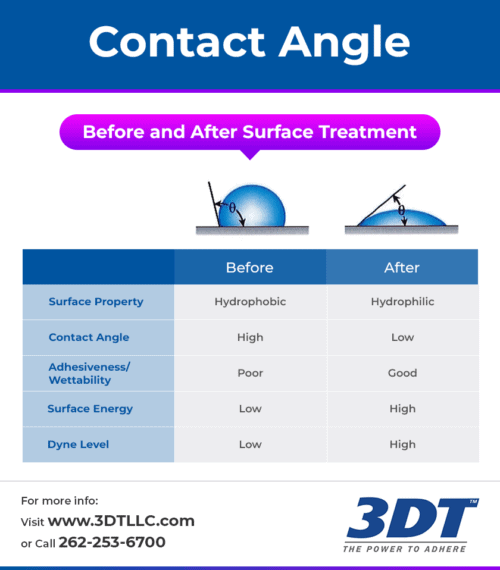
Generally, companies do not have robust process controls that ensure 6-Sigma quality. For ink printing processes surface quality is critical. Ballistic deposition Contact Angle meters are superior to liquid dyne testing. Plastics are highly susceptible to surface contaminations from the work environment (including dirt, oils, moisture). Changes in temperature & humidity affects ink flow and viscosity, and the effectiveness of plasma pretreatments.
The inkjet printing process departs from conventional ink printing techniques in that engineering is required in many distinct disciplines for turnkey systems integration. In contrast, manufacturers of pad and screen-printing equipment almost always can provide turnkey systems including inks, printing consumables, curing equipment, automation and chemical clean-up equipment. Inkjet system components consist of the printhead, drive electronics, inks, parts-handling and motion control hardware, and curing irradiator. Further, digital information needs to be communicated to the printhead through hardware/software file protocol including the main controller drive software.
Inkjet printing is an intricate process and not a single piece of equipment. A high degree of engineering knowledge of all the inkjet components and piece-part compatibility is critical to achieving robust manufacturing operations. No printer manufacturer provides all of the mentioned components for every application.
Specific to inkjet printing machines and prospective procurement, companies too often do not conduct adequate testing of samples only to learn that certain inks and UV LED pinning lamps do not produce sufficient power/energy density to achieve full cure. Radiometers are important to determine proper UV dosage. Undercure and overcure conditions result in adhesion/abrasion failure. Inkjet printers require exact setup and maintenance.
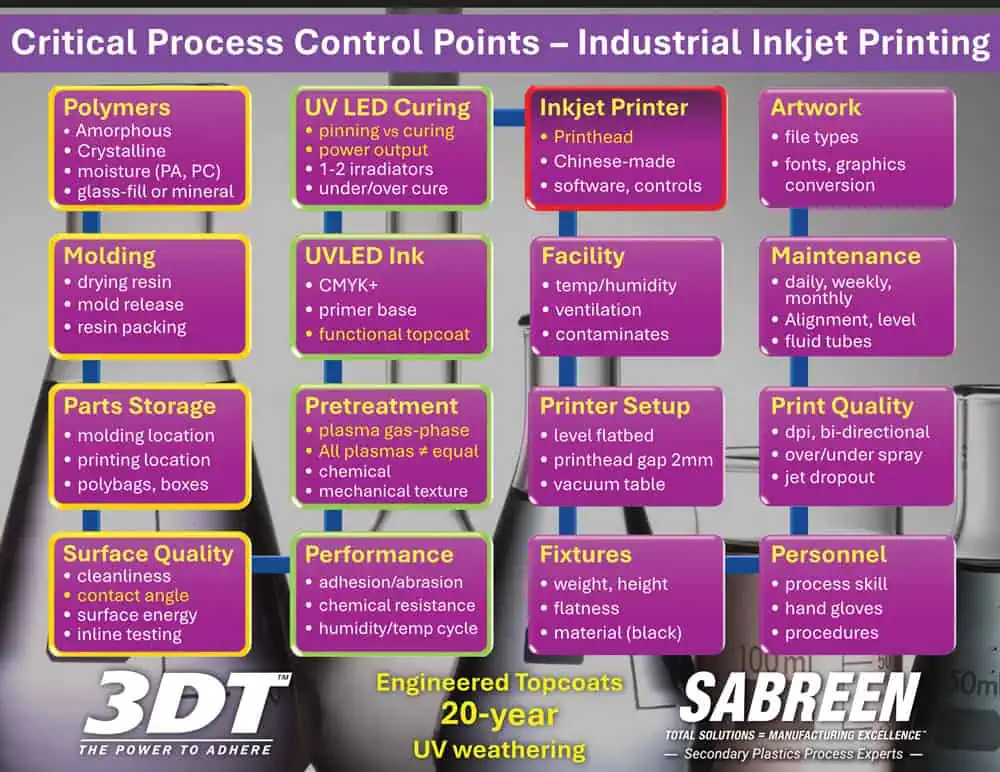
See the informative chart below detailing a wide range of factors that impact quality inkjet printing. Click to expand. Listen to the webinar linked below for a detailed explanation.
2. As a vendor in this space, what are you doing to combat challenges like ink adhesion to plastic?

3DT understands the process intricacies relating to inks and coatings adhesion onto plastics, not only pretreatment.
We work closely with our customers to design and integrate robust production systems. This approach makes it much easier for customers to have a single contact point. Through our strategic business relationships, 3DT has unique capabilities to optimize ink formulations, printhead selection, polymer compatibility analysis, surface quality, and printer selection.
Education is important for companies in order to make the best purchase decisions not only for the types of pretreatment, but for long term project success. 3DT has a “process-centered” focus and we invite customers to view our advanced capabilities.
3. What type of pretreatment processes do you recommend in conjunction with inkjet printers? Are they placed inline, near line, or offline?
Our plasma treatment systems are integrated based on the work flow of our customers. Since we offer integrated plasma pretreatment systems with inkjet printers we understand the design intricacies. When pretreatment heads are mounted onto flatbed systems there are weight considerations for the balance of the reciprocating printhead. For single pass inkjet printing, there are other design considerations.
The specific type of pretreatment is a factor for determining which method is best. We offer ten different surface pretreatment systems, all customizable and built in Germantown, Wisconsin.
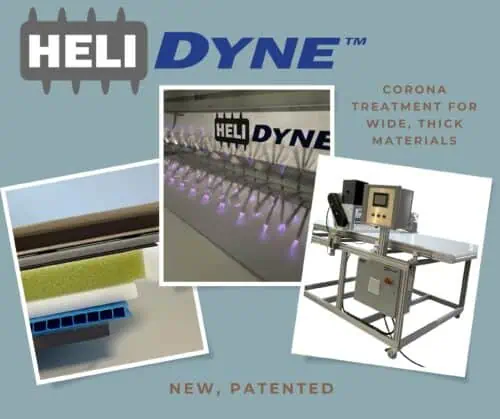
Pretreating rigid parts are much different than pretreating thin, flexible banners. For example, polyolefins are often selected for both rigid and thin material products, however the amount of heat applied is an important factor that determines which of our plasma technologies is best. 3DT’s newly patented HeliDyne corona treatment is excellent for wide, thick materials.
The inkjet printing process departs from conventional ink printing techniques in that engineering is required in many distinct disciplines for turnkey systems integration. In contrast, manufacturers of pad and screen-printing equipment almost always can provide turnkey systems including inks, printing consumables, curing equipment, automation and chemical clean-up equipment. Inkjet system components consist of the printhead, drive electronics, inks, parts-handling and motion control hardware, and curing irradiator.
Further, digital information needs to be communicated to the printhead through hardware/software file protocol including the main controller drive software. No single manufacturer provides all of the mentioned components for every custom application. A high degree of engineering knowledge of all the inkjet components and piece-part compatibility is critical to achieving robust manufacturing operations.
4. Have advancements in ink chemistries made pretreatment processes less necessary?
The simple answer is no. While more types of inks are offered, printing on plastics requires a wettable surface and oxidative chemical functionality. Too often, companies limit their focus on surface wetting and not the polar functional groups introduced onto the surface.
5. Please share information about the pretreatment devices you offer that can be used in conjunction with inkjet printers printing directly to plastic.
 3DT manufactures a full range of surface treatment systems engineered for common industrial printing, decorating, bonding and adhesion demands. 3DT’s systems are designed for adaptability and can be configured to meet the exact requirements of unique applications. Our engineering team collaborates with customers through every stage of system development, including comprehensive application development, dyne testing, design, engineering, and system integration.
Customization may involve selecting the optimal type and number of treating heads, integrating conveyors, mandrels, linear actuators, robotics, part sensing and more. Each system is engineered for integration into production lines delivering precise, consistent, and repeatable surface treatment performance within your production environment. 3DT has 34 years of experience developing surface treatment for umpteen materials and applications.
Regarding inkjet printing on polymers, these systems manufactured by 3DT are vital for successful adhesion and performance of printing ink on polymers:
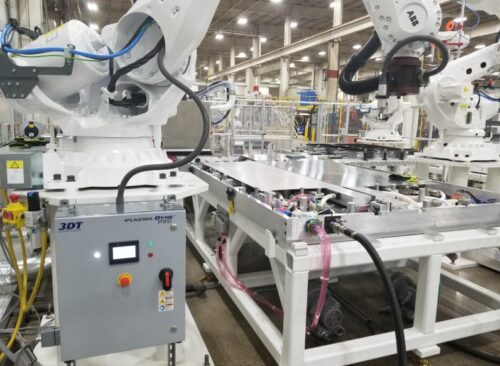
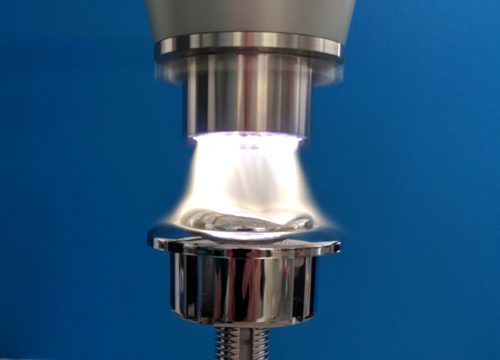
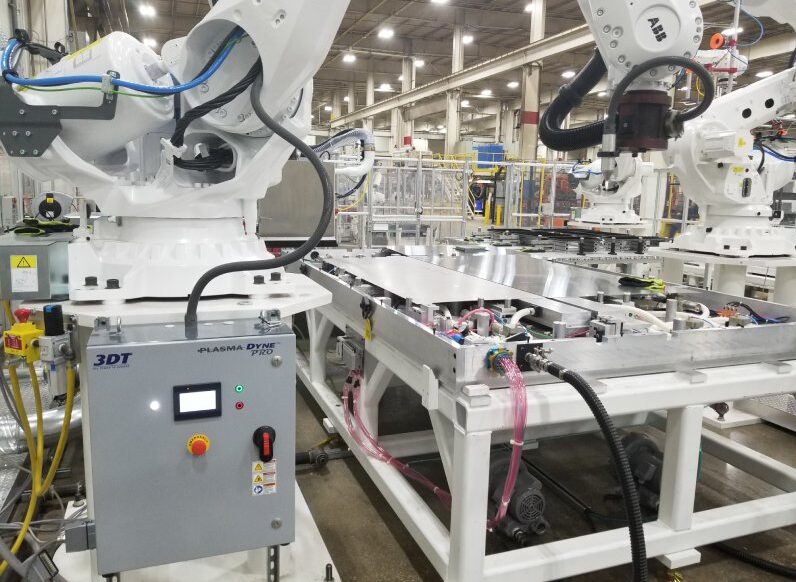
- PlasmaDyne uses atmospheric plasma discharge to improve bonding on a wide variety of products, from sport bottles to photo tiles to sport courts. PlasmaDyne micro-cleans and activates unresponsive polymer surfaces to accept ink, paint, adhesives, coatings, and laminates. It is customizable for numerous applications and processes. The basic system includes these thoughtful features: Remote I/O interface, color touch display, modular replacement parts, and adjustable treatment levels for diverse materials and applications.
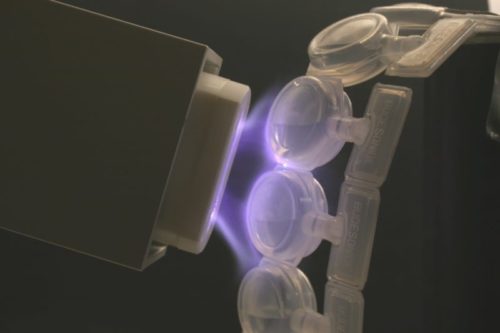
- PolyDyne is ideal for printing, assembly, injection molded and extrusion lines. It is a versatile corona treating system that includes custom-built product handling for each unique application. Common uses include the pretreatment of sheets, panels, foam, 3D parts, labware, and more.
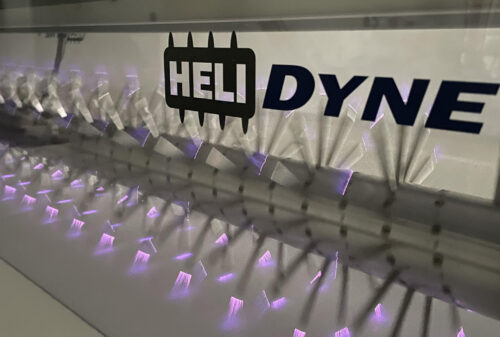
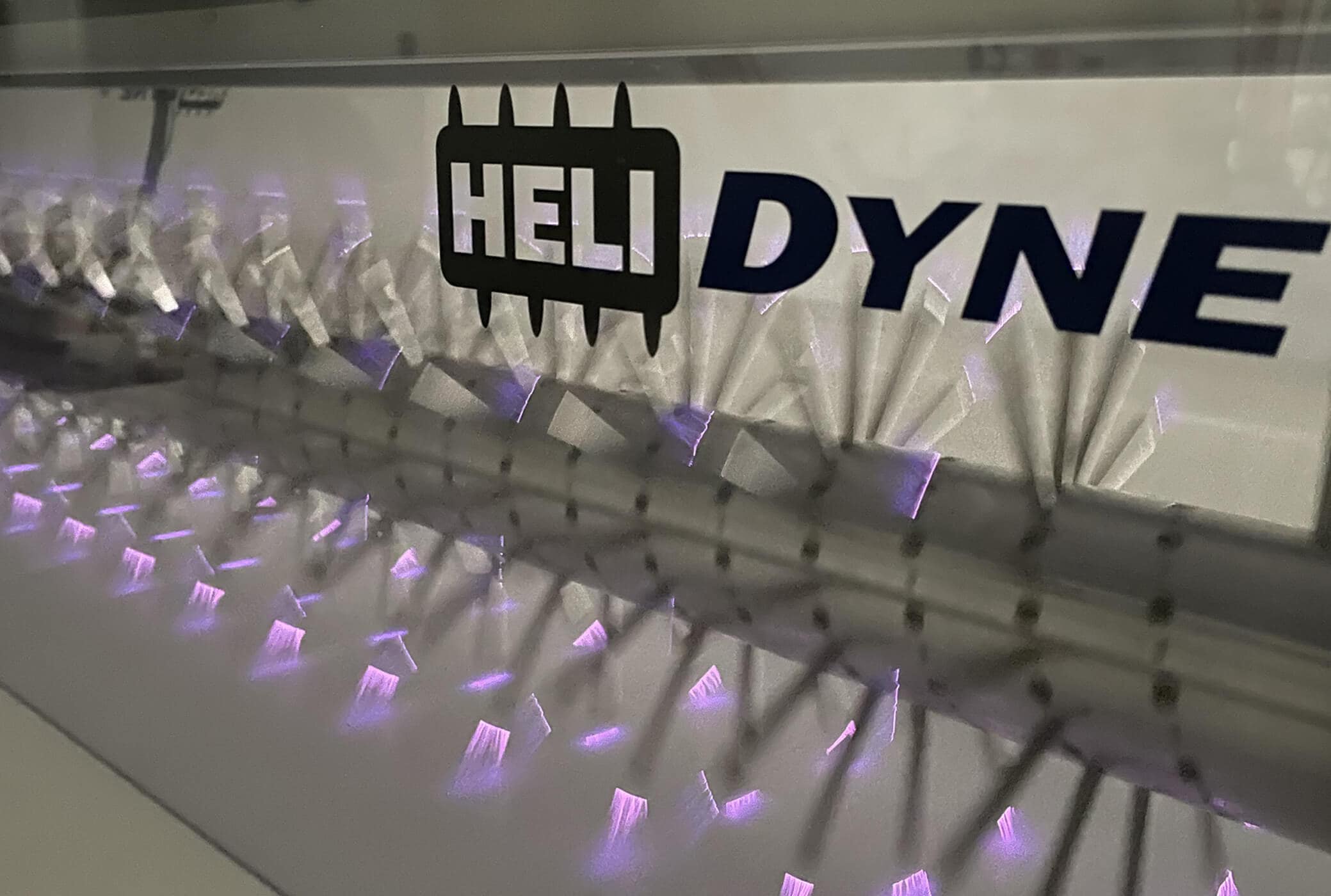
- HeliDyne – Powerful surface treatment and improved adhesion are now possible for wide, thick, porous, hollow, and over-size materials. 3DT’s new, patented HeliDyne corona treatment system was developed to produce strong bonding on these specialized substrates for printing, gluing, coating and laminating applications.
HeliDyne is engineered with numerous pin electrodes, which generate a broad corona discharge that increases surface tension on challenging materials without the heat damage typical of conventional treatment. Unlike most systems, HeliDyne handles materials up to 200 inches wide and 2 inches thick in a single pass. It is fully customizable and can be integrated inline or paired with a conveyor. - UltraDyne corona treatment system was developed to improve the adhesion of ink for high-speed cup/tub/tube printing lines utilizing 3DT’s specialized blade electrode.
The folks at 3DT and the Sabreen Group look forward to answering your questions and discussing your application. Let’s partner in solving your adhesion challenges. Give us a call or send an email at:
3DT LLC: sales@3DTLLC.com – +1-262-253-6700
Sabreen Group: ssabreen@sabreen.com – +1-972-820-6777
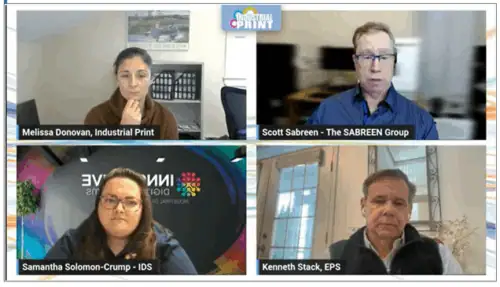
Be sure to view Industrial Print’s companion webinar with a panel discussion regarding direct printing to plastic. The three member panel of industry experts, including Scott Sabreen discuss all aspects of digital printing on plastic weighing factors and solutions. The YouTube webinar is 45 minutes long and can be found at this link.
Here is a link to the full article, Plastic Possibilities – Direct Printing,
in Industrial Print’s November 2025 issue, found on page 27.